One of the first questions patients ask when considering dental implants is whether their jawbone is strong enough to support them. It’s a valid concern, and the answer isn’t always a simple yes or no. If you’ve been missing teeth for a while, you may have lost some bone in that area. But that doesn’t mean implants are out of the question. In many cases, bone grafting can rebuild what’s missing and create the foundation you need.
Why Bone Loss Happens
Your jawbone stays healthy because it gets constant stimulation from your tooth roots every time you chew. When a tooth goes missing, that stimulation stops. The bone in that spot slowly begins to break down and shrink, a process dentists call resorption.
This isn’t something you can see or feel. It happens quietly over months and years. By the time you decide to get an implant, you may have less bone than you started with. This is completely normal, and it’s one of the main reasons we always start with a thorough examination and a cone beam CT scan before recommending any treatment.
How We Check Your Bone
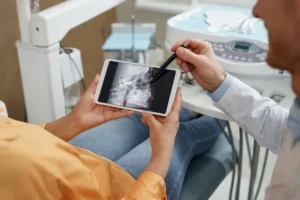
In the past, dentists could only guess at your bone level using flat X-rays. Today, we use a cone beam CT scanner, which gives us a three-dimensional image of your jaw. This allows us to measure your bone height, width, and density with incredible precision.
An implant is a small post that needs to be anchored securely. We need to know exactly what we’re working with before we place it. The CT scan is painless and gives us all the information we need to plan your treatment safely. It also helps us identify if a bone graft is needed and, if so, exactly where and how much.
What Is a Bone Graft?
A bone graft sounds more intimidating than it actually is. In simple terms, it’s a procedure where we add bone material to your jaw to create a thicker, stronger base for the implant.
The material we use is highly advanced. It’s often a special bone protein that stimulates your body to grow new bone right where we need it. This material is safe, biocompatible, and over time, it fuses with your natural bone to form a solid foundation. In many cases, we can place the graft and the implant during the same appointment. In others, we may give the graft a few months to heal before placing the implant. It all depends on your specific situation.
How You Heal
If you need a graft, recovery is straightforward. You’ll likely experience some mild swelling and tenderness for a few days, similar to having a tooth extracted. Over-the-counter pain relievers and a soft-food diet usually manage these symptoms well. Your body does the rest.
The real magic happens beneath the surface. Over the next several months, that graft material will encourage your own bone to grow and fill the space. It’s a natural process that we help along with careful planning.
You Have Options
Many patients worry that they can’t afford implants or that the process will be too complicated. But bone grafting has become a routine and very predictable part of implant dentistry. It’s a standard solution for a very common problem.
If you’ve been told in the past that you don’t have enough bone, don’t lose hope. The technology and techniques available today are much more advanced than even a few years ago. A consultation is the best way to find out what’s possible for your specific situation.
To learn more about your options, you can call Revive Dental and Implant Center at 304-396-6658 to schedule an appointment. You can also request an appointment online.