It’s a frustrating moment. You’ve decided to replace your missing teeth, done the research, and made the appointment. Then the dentist tells you that you’re not a candidate for implants.
The reasons vary. It could be bone loss, gum disease, or the complexity of the case. Sometimes it’s just that the practice doesn’t offer the treatment and would rather refer you than admit it.
Whatever the reason, the message is the same. “Implants aren’t for you.” That message can feel final, but it usually isn’t.
Dr. Chad Boustany is a prosthodontist at Revive Dental and Implant Center in Charleston, WV. He’s one of the few prosthodontists in the state, and his specialty training focuses on solving the cases that general dentists refer out. Many of the patients who come to his office have already been told “no” somewhere else. For many of them, the answer turns out to be “yes.”
Here’s why that happens, and how to know whether a second opinion is worth seeking.
The Five Reasons Patients Hear “No”
When a dentist tells a patient they’re not a candidate for implants, the reason usually falls into one of five categories. Understanding which one applies to you tells you a lot about whether another opinion is worth pursuing.
1. Not Enough Bone
This is the most common reason, but bone loss isn’t a permanent disqualifier. Techniques like tilted implant placement (as in All-on-4) can often work with the bone that’s available, even in patients who’ve been told their bone is too thin. Bone grafting is also an option in many cases, and a prosthodontist is trained to evaluate both.
2. Active Gum Disease
This is a legitimate concern. You need healthy gums for an implant to succeed, but gum disease is treatable. If it can be brought under control, you may become a candidate. The question isn’t “do you have gum disease,” it’s “can it be treated, and how long will it take?”
3. Medical Conditions or Medications
Conditions like uncontrolled diabetes and medications like bisphosphonates raise real questions about implant candidacy. But a specialist with experience in complex cases is more likely to evaluate the specifics. Is the diabetes well controlled? Is the medication ongoing or historical? These are conversations, not checklists.
4. Smoking
Smoking increases the risk of implant failure, but it doesn’t automatically disqualify you. A candid specialist will explain the risk, discuss what you’d need to commit to, and let you decide.
5. Complexity Beyond the Practice’s Capability
This is the reason that rarely gets said out loud. A general dentist may refer out cases involving full-arch reconstruction, significant bone loss, or complex bite issues because they don’t have the training, tools, or team to handle them. That’s a responsible choice, but it doesn’t mean the case is impossible. It means it’s beyond that particular practice.
If you were told “no” because of reason five, a second opinion from a prosthodontist is almost always worth seeking.
What a Prosthodontist Brings to the Table
Prosthodontics is one of the nine dental specialties recognized by the American Dental Association. A prosthodontist completes an additional residency focused on repairing and replacing teeth and oral structures.
Dr. Boustany’s training included a three-year prosthodontic residency at West Virginia University, where he earned both his certificate of specialty training and a Master of Science in Prosthodontics. That’s not a weekend course. It’s a full specialty education in managing complex reconstructive cases.
That training matters for a patient who’s been told “no,” because a prosthodontist’s entire specialty is built around solving problems that general dentists can’t. When a case involves significant bone loss, a collapsed bite, multiple missing teeth, or a combination of issues, the prosthodontist’s training is exactly what’s needed.
The practice is also equipped with technology that most general dental offices don’t have. 3D imaging shows the bone, nerve pathways, and surrounding structures in detail. Digital smile design and CAD/CAM let the team plan the final restoration before any surgery happens. And the on-site lab, with 3D printing, 3D milling, and acrylic prosthetic manufacturing, means restorations can be fabricated with a level of precision and control that’s hard to match elsewhere.
For a patient who’s been told their case is too complex, that combination of training and technology is often the difference between “no” and “yes.”
What All-on-4 Was Designed For
One of the most common reasons patients are told they’re not candidates is bone loss. And one of the most important things to know about All-on-4 in Charleston is that it was specifically designed for patients in that situation.
Traditional implant treatment often requires one implant per missing tooth and a certain amount of bone for each one. If the bone isn’t there, grafting is needed before implants can be placed.
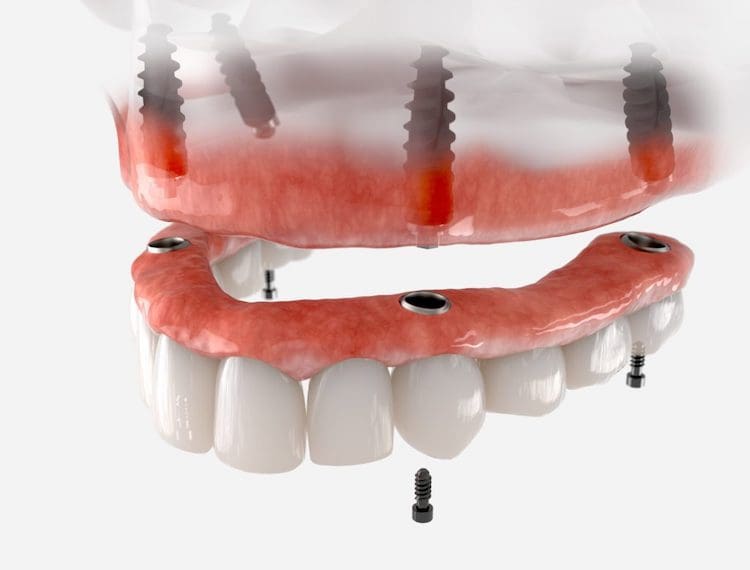
All-on-4 takes a different approach. It uses four implants per arch, with two placed straight in the front and two tilted up to 45 degrees in the back. The tilted implants allow the surgeon to anchor into the densest available bone, even in patients who’ve experienced significant resorption. In many cases, this eliminates the need for bone grafting entirely.
That’s why All-on-4 has become the go-to solution for patients who’ve been told they don’t have enough bone for traditional implants. The technique was developed specifically to solve that problem.
A prosthodontist trained in All-on-4, with the imaging technology to plan it precisely, can often help patients a general dentist would have referred elsewhere.
What a Second Opinion Actually Looks Like
If you’ve been told you’re not a candidate, here’s what a second opinion at Revive Dental and Implant Center involves:
- A Conversation: Dr. Boustany starts by asking what you were told and why. If you have records from the other office, bring them. If not, he’ll take his own imaging.
- The Evaluation: He examines your teeth, gums, bite, and bone. He takes 3D imaging to see exactly what’s happening beneath the surface.
- The Honest Assessment: He’ll tell you whether the original “no” was correct. If it was, he’ll explain why and talk through alternatives. If it wasn’t, he’ll explain what’s possible and what the plan would look like.
- The Plan: If implants are possible, he’ll walk you through the timeline, the steps, and what to expect. If a preparatory procedure like grafting is needed, that will be part of the plan.
- The Next Steps: You’ll leave with a clear understanding of your options, not a sales pitch.
You don’t have to commit to anything at the second opinion. You just need to find out whether the “no” you heard was final or just a “no” from that particular office.
Why Patients Travel to Charleston for This
Revive Dental and Implant Center serves patients from Charleston, Huntington, Teays Valley, Hurricane, Winfield, Beckley, Logan, and across the Tri-State area. Many of them come specifically because they were told “no” somewhere closer to home.
The reasons vary. Some were told they didn’t have enough bone, while others were told their case was too complex. Some were told they’d need procedures that their local dentist couldn’t perform. In each case, the answer at Revive was different.
That’s not because the practice promises miracles. It’s because a prosthodontist’s training and the right technology can change the answer for patients whose cases fall outside the scope of a general dental practice.
Dr. Boustany’s background includes building one of Colorado’s leading dental implant centers before returning to West Virginia to found Revive in 2020. He’s seen thousands of cases, including many that other practices declined. His specialty is the complex ones.
Learn more about our dental implant services:
- Same Day Dental Implants
- Benefits of Tooth Replacement
- Bone Grafting
- Cost of Dental Implants
- Dental Implant Candidates
- Remote Anchorage Implants
- Complete Fixed Bridge
- Multiple Teeth Implants
- Overdentures
- Partial Fixed Bridge
- Single Tooth Implants
- Sinus Lift
- Trefoil Implant System
What to Bring to a Second Opinion
If you’re considering a second opinion, bring:
- Your records from the other office. X-rays, treatment plans, and any notes you can get. If the office won’t share them, that’s useful information too.
- A list of your medications. Medical history matters for implant candidacy.
- A list of your questions. Write them down before you come in so you don’t forget.
- An open mind. The second opinion might confirm the first one. Or it might open a door you thought was closed. Either way, you’ll leave with more information than you had before.
Where to Find Us
Revive Dental and Implant Center is at 4803 MacCorkle Ave in Charleston, WV. We serve patients from Charleston and across the Tri-State area, including Huntington, Teays Valley, Hurricane, Winfield, Beckley, and Logan.
Call us at 304-396-6658 or request an appointment online. If you’ve been told you’re not a candidate for implants, we’ll take a fresh look, show you the imaging, and give you an honest answer.